



Appoquinimink Meeting Honors Abolitionist John Alston 152 Years After His Death
In 2007, the U.S. National Park Service evaluated the site of Appoquinimink Meetinghouse in Odessa, Del., as “making a significant contribution to the understanding of the Underground Railroad in American history and it meets the requirements for inclusion in the National Underground Railroad Network to Freedom.” The Delaware segment of the Harriet Tubman Underground Railroad Byway passes directly in front of the meetinghouse on Route 299, Odessa’s Main Street.
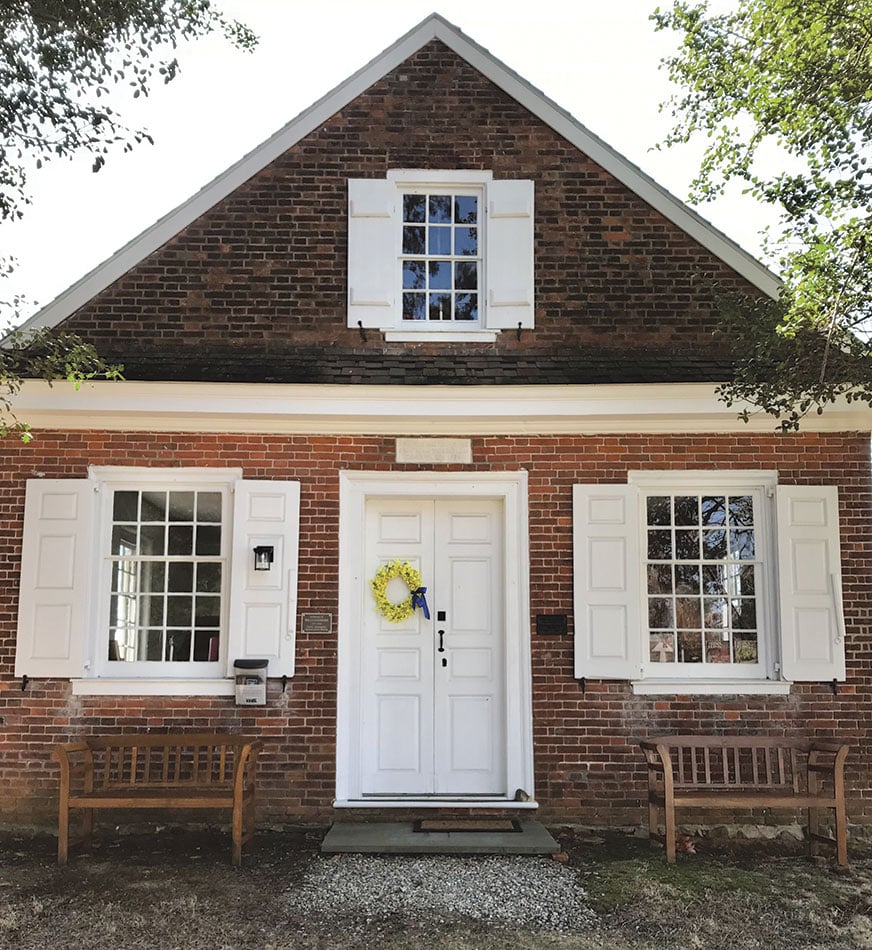
Lacking plumbing and air conditioning, Appoquinimink Meetinghouse is largely unspoiled by modernity. It is bordered by two burial grounds, one of which is restricted to descendants of a single Orthodox family. Reading Appoquinimink’s applications for acceptance to the National Register of Historic Places, one name stands out: John Alston (1794–1874), who at the time of his death was the only active member of the meeting.
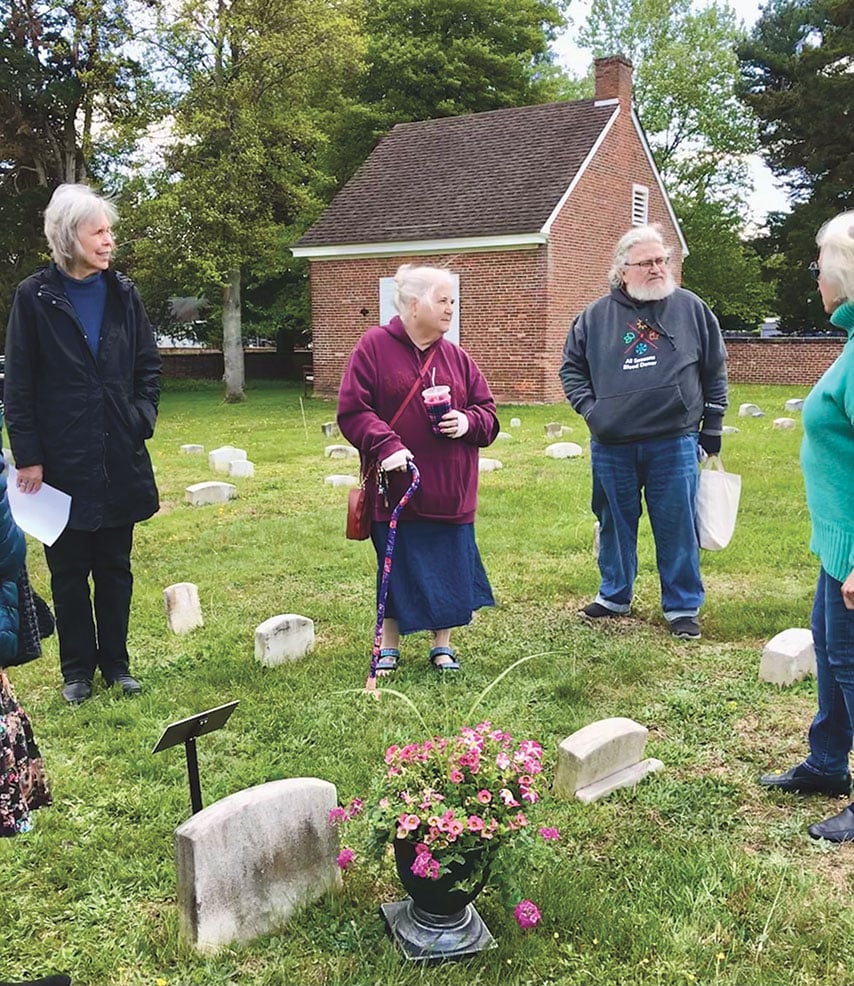
The challenge became to locate Alston’s grave marker among the many on the meetinghouse grounds. We found one for John Cowgill Alston, but the dates (1869–1950) did not match. Through additional searching, over six years ago, John Alston’s grave was identified nearby but the marker was nearly illegible due to acid rain and ageing.
For too long Alston has stood in the shadow of his younger, better known cousin, John Hunn (1818–1894), a farmer, Quaker minister, and abolitionist who was a “station master” of the Underground Railroad in Delaware. Hunn’s name also features prominently in the historic places application, as his active participation with assisting escaping slaves began in 1844 while he was living in Odessa.
Alston saw to the needs of Appoquinimink Meeting from 1830 until his passing in 1874. A long dormant period followed until about 1938 when the meeting reopened. Local Friends kept it going, then the arrival of Wills Passmore and his family in the early 1960s led to improvements such as electrical heating and lighting. In 2016 the torch was passed to this author to see to Appoquinimink’s needs. A box of very miscellaneous documents of the meeting’s recent past created the foundation of the library therein.
The decision to wait no longer to bring John Alston’s life story to the fore was made in part because Appoquinimink’s newest attenders were unaware of Alston and Hunn’s pre-Civil War activities on Delaware’s Underground Railroad.
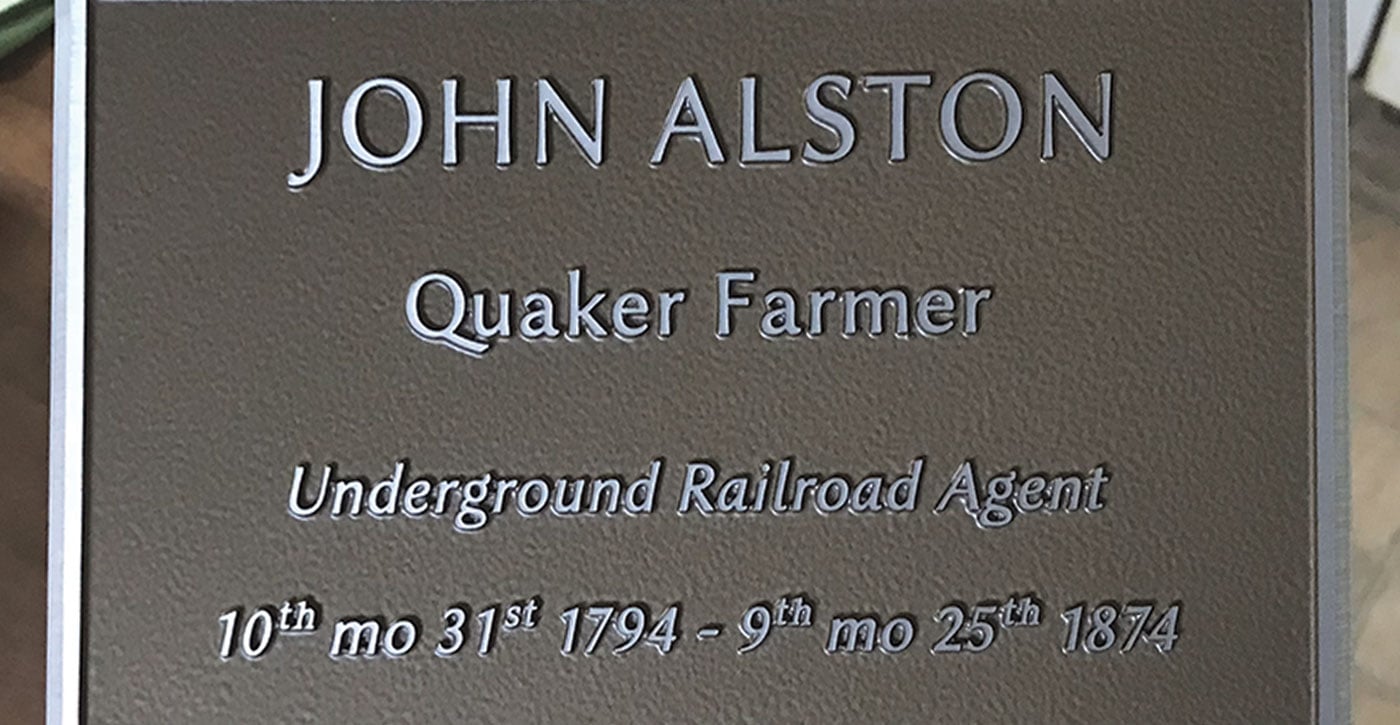
So on a Sunday morning this past May, the Friends of Appoquinimink Meeting gathered to honor the late John Alston with a plaque that commemorates his dedication to abolitionism in the nineteenth-century village of Cantwell’s Bridge, later named Odessa. Alston’s plaque echoes the dates inscribed on his grave marker with the modest addition of the words “Quaker Farmer / Underground Railroad Agent.” In addition to the plaque, I’ve written a tribute to Alston (see below) in the style of a Friends Journal milestone. May this Friend’s life and legacy continue to inspire Friends today.
John Alston
Alston—John Alston, 79, on Ninth Month 25, 1874, at home near Middletown, Del. John was born Tenth Month 31, 1794, in Kent County, Md., the son of Joab and Hannah Lamb Alston, members of Cecil Meeting in Maryland. John was their fourth child, the others being Joshua, Abner, and Susanna.
The Alstons transferred their membership to Duck Creek Meeting in Delaware in Fourth Month 1798. In 1800, David Wilson Sr., of Cantwell’s Bridge, Del., deeded a parcel of land to a group of Friends, including Joab Alston, “in trust for the Society of Friends (or the people called Quakers), the said lot whereon stands a Brick Meeting-house.” That building was Appoquinimink Meetinghouse, erected in 1785 on Wilson’s farm property.
It’s uncertain how the Alston children were educated. They may have attended the Friends school that existed as early as 1735 near land on Main Street in Cantwell’s Bridge. John Alston mentored his young cousin, John Hunn (1818–1894), and was responsible for Hunn’s relocating to a farm in Middletown, Del.
John Alston hired many free Blacks to work on his farm. The labor contracts he signed remain in his papers. His personal library contained antislavery material. His papers donated to the Friends Historical Library at Swarthmore College include an antislavery tract by John Woolman.
The historic split among Quakers beginning in 1827 resulted in two sects, Orthodox and Hicksite. Appoquinimink and all of the Southern Quarter meetings aligned with the Hicksites. Many wealthy Quakers chose the Orthodox sect, leaving behind John and a few other Hicksites to attend at Appoquinimink. In 1830, John commenced serving as treasurer. In his manuscript ledgers, he meticulously noted debits and credits, to whom payments were made and for what purpose. They are the only known nineteenth-century Appoquinimink documents. They describe an active, functioning meeting.
John Alston didn’t detail his Underground Railroad activities, understandably, as it was illegal to aid self-liberators. John, his cousin John Hunn, and Daniel Corbit were known as Friends to whom Samuel D. Burris of Dover, Del., a free Black Underground Railroad conductor, was directed as he led freedom seekers north. Hunn related an account to William Still of his cousin John sheltering a “bonds-woman” named Molly, which Still recorded in his 1872 book titled The Underground Railroad.
Around 1841 John Alston built a large brick homestead he called “Oakdale,” making it ready for company when Friends traveled through the area to attend yearly meeting in Philadelphia, Pa. Other travelers he was concerned about may have been enslaved individuals on the run. In his journal entry for Fourth Month 16, 1841, he wrote, “O Lord My God, Entreat me to redeem and preserve me. Bless and keep me and mine and enable me to keep my heart and house open to receive thy servants, that they may rest in their travels, that this house that thou has enabled me to build, may be holy dedicated unto Thee, of the pilgrims’ rest.”
On Sixth Month 9, 1856, John married Quaker widow Lydia Corbit Cowgill Wilson at Little Creek Meeting, east of Camden, Del. They had three children: Susan Corbit Alston; Lydia Cowgill Alston, who died in 1865 at the age of three; and John Cowgill Alston. All are buried at Appoquinimink Meeting. His widow, Lydia (1823–1899), is buried at Little Creek.
In Ninth Month 1874, John Alston, according to The Middletown Transcript, “dropped dead at his home near Middletown on Friday morning. He was a Friend, and greatly devoted to his faith. He is about the last of that Society in that neighborhood and for the past twenty years has been the sole attendant at the little brick Meeting-house in the west end of Odessa, where he has gone twice a week, regularly . . . to hold silent and lonely meditation.”
He was survived by his wife, Lydia; and two children, Susan and John.
We want to hear from you, not an AI! Please be thoughtful and use your own words. Comments on Friendsjournal.org may be used in the Forum of the print magazine and may be edited for length and clarity.