



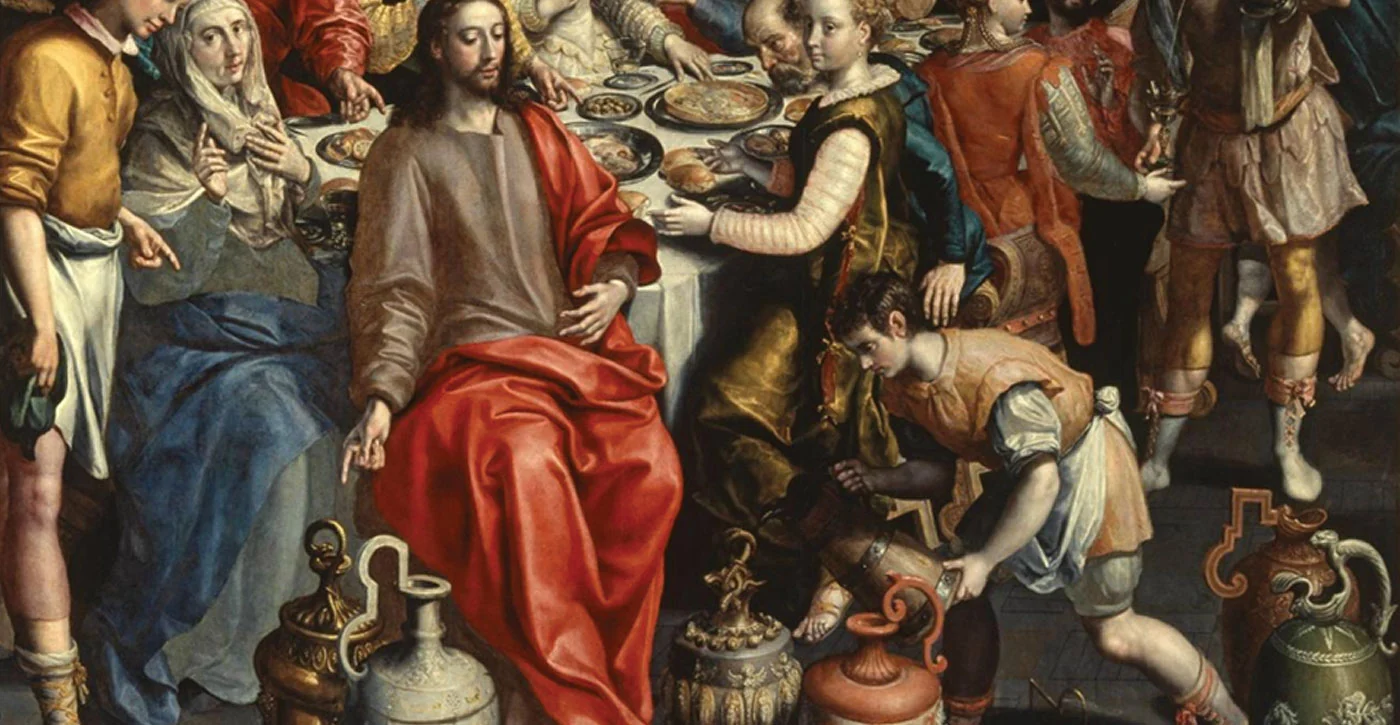
John 2:1–11 (NIV)
On the third day a wedding took place at Cana in Galilee. Jesus’ mother was there, and Jesus and his disciples had also been invited to the wedding. When the wine was gone, Jesus’ mother said to him, “They have no more wine.” “Woman, why do you involve me?” Jesus replied. “My hour has not yet come.” His mother said to the servants, “Do whatever he tells you.” Nearby stood six stone water jars, the kind used by the Jews for ceremonial washing, each holding from twenty to thirty gallons. Jesus said to the servants, “Fill the jars with water”; so they filled them to the brim. Then he told them, “Now draw some out and take it to the master of the banquet.” They did so, and the master of the banquet tasted the water that had been turned into wine. He did not realize where it had come from, though the servants who had drawn the water knew. Then he called the bridegroom aside and said, “Everyone brings out the choice wine first and then the cheaper wine after the guests have had too much to drink; but you have saved the best till now.” What Jesus did here in Cana of Galilee was the first of the signs through which he revealed his glory; and his disciples believed in him.
I have had the privilege of officiating several weddings. Most of the time, these events are spiritually and emotionally supercharged: full of excitement, anxiety, and tension. When I meet with the couple before the ceremony, I prepare them: “Something unexpected will happen. Something unexpected always happens at weddings.” Not wanting to leave them in a state of distress, I quickly reassure them: “But you’ve got good people around you who care about you. We will solve any problems that come up and make sure it’s all about love and celebration. And, at the end of the day, you’ll be married!”
Indeed, something unexpected always happens at weddings, for better or for worse (no pun intended). At the last wedding my wife and I officiated, we introduced the “ring warming ceremony” only to discover that the rings were missing! Thankfully, we were able to improvise—Quaker style—with open sharing. Thankfully, the rings were eventually located, and all was well. The sharing time ended up being a highlight for guests; they felt it added a personal and spiritual quality to the occasion.
Even in Jesus’s time, it seems, something unexpected always happened at weddings. In the Cana wedding story, the issue wasn’t the rings; it was the wine. For traditional Quakers, the wine running out might bring a sigh of relief. It was getting a little too wild for their taste. What’s wrong with water, anyway! But for a Jewish wedding, running out of wine at a wedding was tragic, if not downright shameful.
I love Mary’s simple but suggestive comment to Jesus: “They have no wine.” You can almost hear the subtext: “They have no wine (wink, wink, nudge, nudge). If only there were an up-and-coming messiah who could do something about this perplexing problem. . . .”
Jesus seemed less than amused in his reply. Commentators tell me that “Woman” in this passage isn’t as derogatory as it sounds. It could be translated as “dear woman” or “ma’am.” I believe them, but Jesus still doesn’t sound pleased: “Why do you involve me?”
I have asked that question more times than I can count. It is a frequent internal (if not external) reaction to peoples’ attempts to triangulate me into their drama or coax me into their project. We should resist unhealthy triangulation and overcommitment. But I’ve also learned that sometimes it is as much the Spirit’s nudging as it is the “Mother Mary” figure in my life. A big part of the spiritual life is “getting involved with God,” as biblical scholar Ellen Davis puts it.
Once we get involved, the duty often turns into delight because we realize that, somehow, we get to participate in miracle-making. We get to witness water becoming wine. It becomes a sign of a better world to come. And we become signs of a reality that Jesus called “the kingdom of God.”
Of course, it’s not just weddings where unexpected things happen. All around the world—not least the Quaker world—there are unexpected things happening all the time. We generally experience the unexpected as an unwelcome surprise. It’s hard not to have rising anxiety as we feel pulled into a spiral of scarcity as people declare: “We have no wine.” Many Friends feel like the wine of our movement has run dry, and we are left with only lack: a lack of passion, energy, and resources.
However, “We have no wine” is more than a statement of fact. It is also a nudge to faithfulness. It names a problem and possibilities at the same time—in the same way that a breakdown can lead to a breakthrough, a rock bottom can be the beginning of recovery; an apology can lead to reconciliation. “Limitation and possibility mean about the same thing,” wrote Flannery O’Connor.
Miracles of any kind generally start naming reality and facing facts, and accepting limitations. Paradoxically, this recognition of what’s absent and negative can help us turn to what is present and possible. If we resist the spiral of scarcity, the practice of counting the “five loaves and two fishes” can jump-start the miracle of feeding the multitude (to borrow from another Jesus story). “You don’t know what you need from outside until you know what you have inside,” instructs community development consultant John McKnight. (And often, we have more than we thought.)
In Cana, Jesus took what was present—the old ceremonial jars—and filled them with water, trusting that some kind of Power or Presence would work in the process to bring transformation. This event was the first of many miracles for Jesus. And it all started with a nudge. Give credit where credit is due—a concerned guest, a faithful woman, and an assertive mother.
As Friends, we emphasize the gentle nudges of the Spirit. Only One can truly speak to our condition. Humans are prone to manipulation and domination. We easily drift from nudging into nagging.
And yet, sometimes we do need a Friendly nudge from someone we trust. And sometimes we are called to nudge others to “get involved” with God and neighbors in some kind of problem turned opportunity, limitation turned possibility, scarcity turned abundance. If we are anywhere in that mix, we get the privilege of partnering with God in miracle-making.
Discussion Questions
- How do you know when you are being nudged to get involved in something?
- When have you been the “nudger” and when have you been the “nudgee”?
- What situations of scarcity in our Society might be poised for transformation?


We want to hear from you, not an AI! Please be thoughtful and use your own words. Comments on Friendsjournal.org may be used in the Forum of the print magazine and may be edited for length and clarity.