



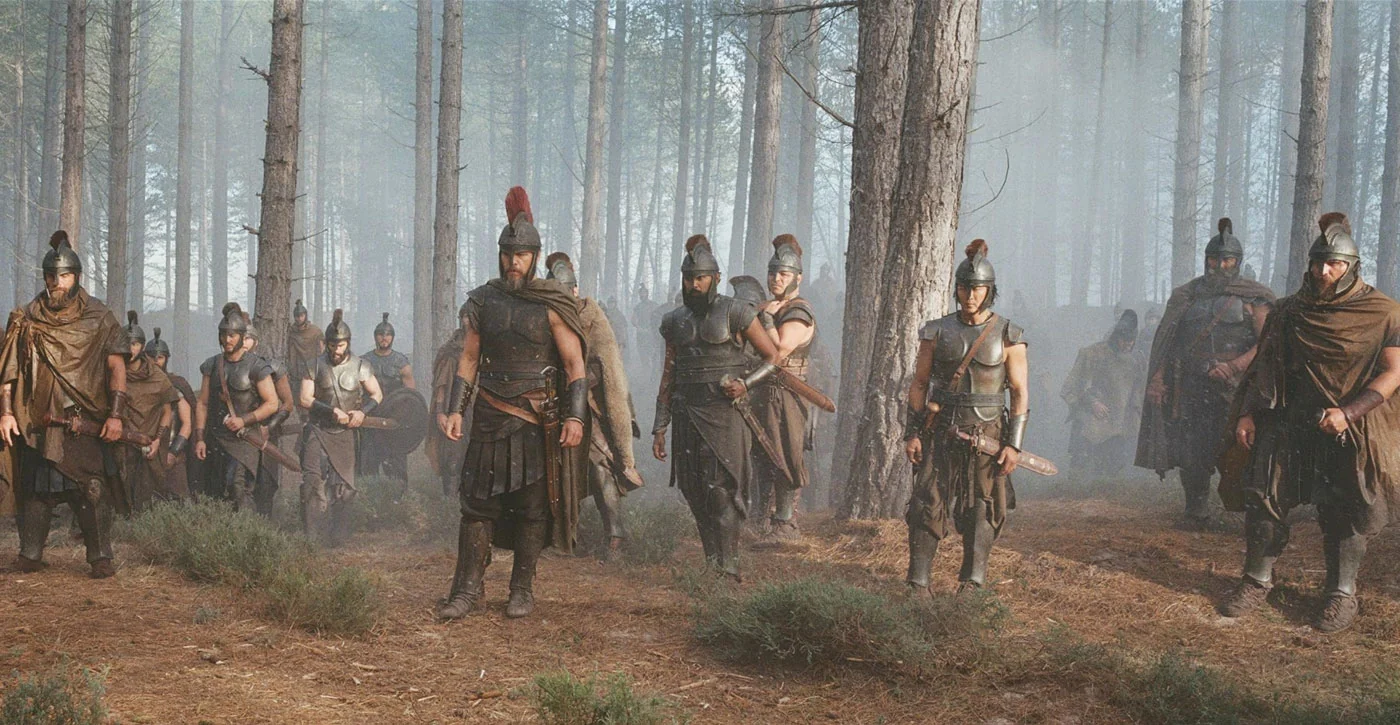
Christopher Nolan’s Antiwar Epic
I was eager to see Christopher Nolan’s The Odyssey because I have loved Homer since childhood, when my Greek father gave me Jane Werner Watson’s marvelous, illustrated translation of The Iliad and the Odyssey—a copy I still own. I studied Homer in college and initially planned to major in classics, but after taking a poetry workshop by Anne Sexton, I chose literature instead. Over the years, I have perused nearly every translation of Homer: from Alexander Pope’s to Emily Wilson’s.
Some have called for boycotting the film because parts of it were filmed in the Western Sahara, a contested area where the Indigenous Sahrawi people are resisting Moroccan occupation of their land. I chose to make a donation to Nonviolence International’s Western Sahara solidarity campaign to support their cause.
Nolan’s film has also rightly been criticized for not being faithful to Homer, but the filmmaker, it seems, had a very different purpose. Nolan has said in interviews that he wanted to portray the imminent collapse of Hellenic civilization as a parable for our time. He also wanted to show the traumatizing effect of war on the survivors.
Most scholars agree that the epics attributed to Homer were written down in the seventh or eighth century B.C.E., though the events they describe likely date back hundreds of years to around 1200 B.C.E. or earlier when the Greek city-states were flourishing. Many believe this civilization collapsed after marauders known as the “Sea Peoples” disrupted trade and ruthlessly destroyed cities in the eastern Mediterranean. For nearly four centuries, the Greeks had no written language, abandoned their cities, lived in villages, and produced little by way of art or architecture. During this dark age, the Homeric narratives were preserved orally by poets called “rhapsodes.”
Nolan’s film makes several references to the Sea People as a looming threat. The film also makes clear that the Trojan War set the stage for their invasion and destruction of Hellenic civilization.
Odysseus is not portrayed as a wily, articulate strategist with a gift for lying shamelessly and making up stories convincingly. This cleverness was admired by many Greeks (including Athena, the goddess of wisdom) but despised by “pious” Romans. (“Beware of Greeks bearing gifts” is a line by the Roman poet Virgil, referencing the Trojan horse.) Instead, Nolan portrays Odysseus as a broken man: suffering from PTSD and guilt-ridden for causing the massacre that took place in Troy, as well as the deaths of his many men.
Much of The Odyssey focuses on what is called “Zeus’s law,” the law of hospitality. In the Homeric world, guests were supposed to be treated with kindness and respect—even beggars, who might be gods in disguise. Zeus’s law is reminiscent of Hebrews 13:2, which states: “Do not forget to show hospitality to strangers, for by so doing some people have shown hospitality to angels without knowing it” (NIV). This is an allusion to Abraham, who showed hospitality to strangers that turned out to be God’s messengers. The Greek term for such hospitality is philoxenia (love of the stranger or guest), the opposite of xenophobia. It is a core value of the Abrahamic faiths, including Quakerism.
This movie reeks of violence, but it is never glorified. David Swanson, the brilliant antiwar writer, sums up the film’s brutally realistic depiction of war in a piece for ProgressiveHub.com:
Nolan de-glorified war. In this movie, we’re told that the Greeks were led into the Trojan War for economic reasons. The warriors were forced into the war through threats to their families and towns. The war was boring and wasteful. Then it was horrific, evil, and traumatizing. Then it tore down the rule of law and spread fear and insecurity across the world. Odysseus, in this film, took so long getting home because he was recovering from the moral guilt, horror, trauma, and grief of war. . . . There was not one decent thing about the whole filthy enterprise, apart from the misdirected bravery.
Swanson also points out that the movie’s ending seems to justify the massacre of the suitors who invaded Odysseus’s home to court his wife, but I disagree. Homer does justify the revenge perpetrated by Odysseus, but Nolan does not. There is nothing glorious about Odysseus’s orgy of violence, which Nolan graphically depicts. So heinous is Odysseus’s bloodthirsty revenge that he feels compelled to go into exile with Penelope, leaving their son behind to rule over a deeply traumatized community. Odysseus effectively becomes a refugee, pushed away from his home once again. Not exactly a happy ending.
Nolan’s Odysseus is in some ways comparable to his J. Robert Oppenheimer, whom Nolan examined in his 2023 film as a tragic figure consumed by hubris. Oppenheimer created weapons of mass destruction that he later came to regret, fearing that they would lead to the end of civilization. Odysseus created a weapon of mass deception, the Trojan horse, that led to the horrific fall of Troy and paved the way for a breakdown of values that knit together Hellenic civilization.
Although The Odyssey does not address the threat of nuclear armageddon as Oppenheimer did, it is worth noting that Nolan has shown deep concern about nuclear war. As a Quaker, I was pleased to learn that he expressed appreciation for peace activists in his acceptance speech for best director at an awards ceremony in 2024: “I do just want to acknowledge [those] who have fought long and hard to reduce the number of nuclear weapons in the world. . . . They show the necessity and potential of efforts for peace.”
Nolan clearly made The Odyssey with our own time in mind. We are witnessing the erosion of the fragile system of international law and values built after World War II to prevent the horrors that scarred the first half of the twentieth century. As imperfect as that system was, it is now giving way to something worse: the collapse of international law and the amoral doctrine that “might makes right.”
What Nolan calls Zeus’s law—the obligation to welcome strangers and treat them with kindness—is being replaced by anti-immigrant xenophobia, in many nations worldwide. Under the 1951 UN Refugee Convention, asylum seekers are to be protected from returning to the persecution they fled. The Trump administration has all but repudiated that Convention, and many other nations (including Greece) no longer welcome refugees as they once did.
Are we moving toward a civilizational collapse like the one that befell Homeric Greece? It can feel that way. Yet my Quaker faith affirms “the necessity and potential of efforts for peace,” as Nolan put it. As Quakers, we have a crucial role to play in fostering what Martin Luther King Jr. called a “revolution of values.” We must also put our faith into practice by welcoming refugees and asylum seekers, as many Quakers have already done, and by standing in solidarity with groups like Veterans for Peace and others who, like Odysseus, know the trauma and tragedy of war firsthand and choose to seek a peaceful world.


We want to hear from you, not an AI! Please be thoughtful and use your own words. Comments on Friendsjournal.org may be used in the Forum of the print magazine and may be edited for length and clarity.