



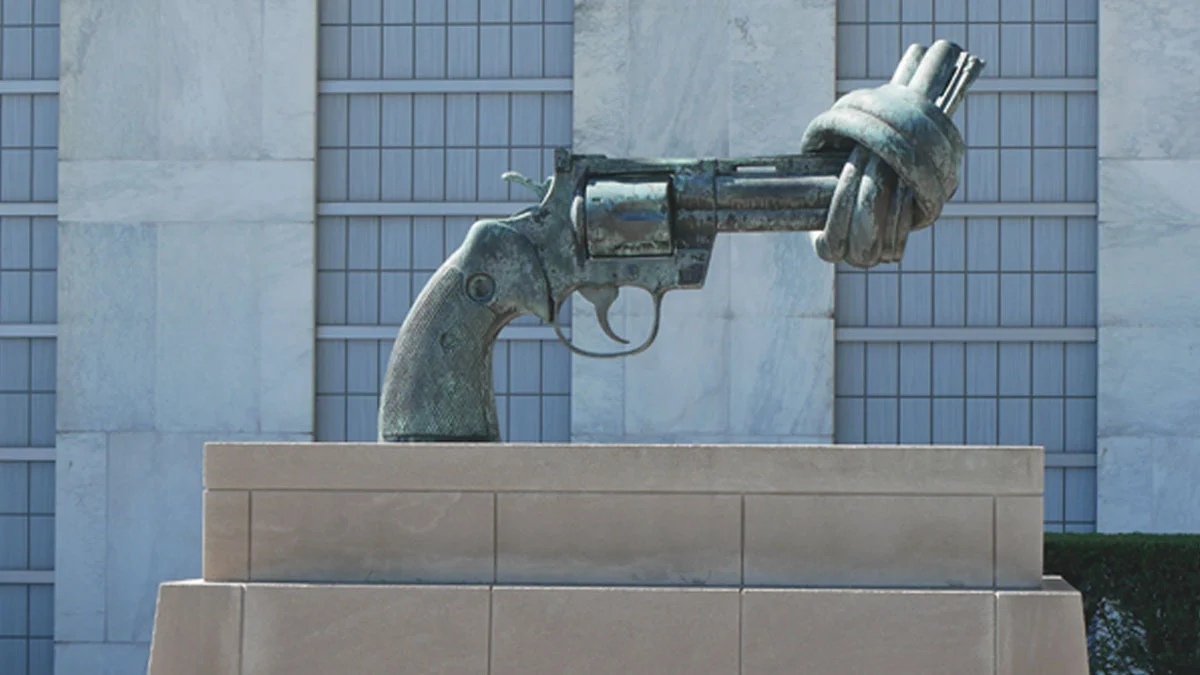
Peace has been a guiding principle for Quakers for a very long time. In 1660, just eight years after George Fox began to gather together what would become the Religious Society of Friends, a pamphlet now known as “The Declaration of 1660” was circulated. It is one of the earliest articulations of the Quaker peace testimony. The authors of this document were not shy about it: “And this is our Testimony to the whole World”:
The Spirit of Christ which leads us into all Truth will never move us to fight and war against any man with outward weapons, neither for the Kingdom of Christ nor for the kingdoms of this world.
Given the propensity of the world’s earthly powers toward domination and war, Quakers have had occasion to test this testimony many, many times in the 366 years since then. And with good reason! After all, a Quaker testimony that goes unexamined is not a testimony at all, but a creed by another name.
Guatemalan Friend Gustavo Recinos considers the difficulty—and necessity—of practicing peace within a Quaker community, so that Friends’ peaceful example can better influence the broader world. His call is threaded through with a lament that conflict within his Quaker church community has discouraged many of the faithful, over the course of a generation. I wonder how many readers will see their own communities’ conflicts mirrored in Gustavo’s descriptions.
Another first-time Friends Journal contributor, Andrew Gorby, shares his experience of being a modern-day Quaker conscientious objector, lifting up the urgency of peacefulness as well as the agony of feeling not peaceful enough, of having waited too long to express the truth of how he felt God calling him to act and witness.
A trio of Quaker Alternatives to Violence Project facilitators share their experience of leading workshops that blended AVP practice with trauma relief in Ukraine during Russia’s war of aggression. While the authors are clear that a workshop will not end the war, they testify to the real spiritual respite that focused peaceful practice can bring to the victims of war—a powerful and hope-filled example of nonviolent resistance.
I’m sure many Quakers have, at some time, been pressed by skeptics to defend pacifism with a trap question along the lines of: “Well, what about Hitler?” Welsh Friend Dewi Heald tackles this dilemma head-on in “It’s Not Just About War.” Reading it has prepared me well for the next time I’m asked about pacifism. Imagine two worlds, one where everyone chose peace, and another where everyone chose war. Which world would you want to live in? And if it’s the former, why are pacifists the ones who have to defend their stance?
We last examined the peace testimony with a special issue in 2008. If these articles have whet your appetite for more, you can find that issue archived here: fdsj.nl/peace2008. You can also find six more articles by Friends around the world in the online edition of this issue.
Finally, I’d like to express gratitude to a treasured volunteer, Hartley Goldstone, who is concluding his service as Friends Journal’s milestones editor, a role he has been fulfilling for six years. Our readers have been fortunate to benefit from his careful work! We welcome Jennifer Thompson of Atlanta (Ga.) Meeting, who is taking the reins. As Jennifer begins her work, we remind our readers that our Milestones section isn’t just for death notices. If there is a birth, marriage, or transition in your Quaker community, we’d love to note it in the Milestones! Visit Friendsjournal.org/submit-milestones for more information.

We want to hear from you, not an AI! Please be thoughtful and use your own words. Comments on Friendsjournal.org may be used in the Forum of the print magazine and may be edited for length and clarity.